























Flutter for Business Growth: Unlocking Competitive Advantage in 2025
Unlock competitive advantage in 2025 with Flutter mobile app development. Discover how Flutter drives business growth, reduces costs, and enhances user experience.

In the rapidly evolving digital landscape of 2025, businesses face increasing pressure to deliver seamless, high-performance applications across multiple platforms. User expectations are higher than ever, and time-to-market is a critical differentiator. Amidst this challenging environment, Flutter has emerged as a powerhouse, offering a compelling solution for companies seeking to gain a competitive edge. This comprehensive guide explores why Flutter is not just a development tool but a strategic enabler for business growth in the coming years.
The Rise of Cross-Platform Prowess: A New Paradigm for Development
The traditional approach of building separate native applications for iOS and Android often results in duplicated effort, increased costs, and prolonged development cycles. In 2025, this model is becoming unsustainable for many businesses aiming for rapid innovation and widespread market reach. This is where cross-platform frameworks shine, and Flutter leads the pack.
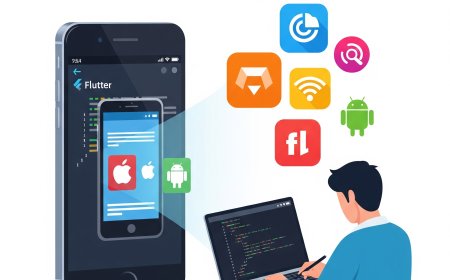
Flutter, Google's open-source UI software development kit, allows developers to build natively compiled applications for mobile, web, and desktop from a single codebase. This significantly streamlines the development process, enabling businesses to deploy their applications across various platforms much faster and more efficiently. The "write once, deploy anywhere" philosophy translates directly into a significant competitive advantage in a market that demands agility.
A Symphony of Efficiency: Accelerating Development and Reducing Costs
One of Flutter's most compelling business advantages lies in its remarkable efficiency, directly impacting development timelines and budgets. The framework's architecture and features are designed to maximize developer productivity.
-
Single Codebase, Multiple Platforms: Imagine creating one set of code that works flawlessly on iOS, Android, web, and even desktop. This fundamental capability of Flutter dramatically reduces development time and costs by eliminating the need for separate teams and codebases for each platform. Businesses that leverage Flutter for mobile app development often report a reduction in total cost of ownership by as much as 40% compared to native development approaches. (Source: Medium, "Business Case for Choosing Flutter in 2025").
-
Hot Reload and Hot Restart: These iconic Flutter features allow developers to see the immediate effects of code changes without restarting the application. This rapid iteration cycle accelerates debugging, testing, and UI adjustments, making the development process incredibly fluid and efficient. This speed is crucial for businesses aiming to quickly prototype, gather feedback, and iterate on their products.
-
Rich Widget Catalog: Flutter provides a vast and customizable set of pre-built widgets that adhere to both Material Design (Android) and Cupertino (iOS) guidelines. This not only speeds up UI development but also ensures a consistent and pixel-perfect user experience across all devices, a key factor in user satisfaction and retention.
Performance That Feels Native: Elevating User Experience
In today's competitive app market, a smooth, responsive, and visually appealing user experience is paramount. Users have little patience for laggy or clunky applications. Flutter excels in delivering a native-like performance, setting it apart from many other cross-platform solutions.
Unlike some frameworks that rely on JavaScript bridges, Flutter compiles directly into native ARM code. This direct compilation results in applications that perform with near-native speed and fluidity, offering seamless animations and swift UI interactions. The ongoing advancements in Flutter, such as the full adoption of the Impeller rendering engine across all platforms in 2025, are further enhancing performance by eliminating issues like shader warm-up stutter, ensuring a truly premium user experience on even lower-spec devices. (Source: Medium, "Flutter 2025 Roadmap (Q1-Q4)"). For industries like fintech, e-commerce, or on-demand services, where speed and responsiveness directly impact user satisfaction and conversion rates, Flutter's performance capabilities are a significant asset.
Expert Voices & Consensus: What Thought Leaders Are Saying
Industry experts and thought leaders largely agree on Flutter's growing significance in the enterprise landscape. The consensus points to its unique blend of development speed, cost-effectiveness, and impressive performance as key drivers of its adoption.
According to a 2023 Stack Overflow Developer Survey, 46% of software developers actively use Flutter, solidifying its position as one of the most popular cross-platform development tools available today. This strong developer community support is a testament to its practical utility and growing ecosystem. Experts highlight that Flutter's ability to maintain highly scalable codebases, thanks to robust state management solutions like Provider, Riverpod, and Bloc, makes it a strong contender for long-term enterprise solutions. They emphasize that while Flutter desktop is still maturing, its multi-platform capabilities are increasingly valuable for internal enterprise tools and multi-device workflows. Major brands like Google Pay, BMW, Toyota, and Alibaba have already successfully implemented Flutter apps, showcasing its adaptability across diverse industries. The Hamilton musical app, one of Flutter's early success stories, demonstrated its potential for creating visually appealing and functionally rich cross-platform applications, helping to establish Flutter's robust reputation. (Source: Droids On Roids, "Top Apps Made with Flutter Examples with Insights").
Real-World Success Stories: Flutter in Action
Flutter's impact on business growth is best illustrated through its real-world applications. These examples showcase its versatility and ability to meet diverse business needs.
-
Alibaba's Xianyu: As a leading online marketplace for used goods, Alibaba's Xianyu app leverages Flutter to handle millions of users. The app's efficient rendering and fast loading times, crucial for an e-commerce platform, are a direct result of Flutter's capabilities, providing a seamless and user-friendly experience.
-
myBMW App: This comprehensive assistant for BMW owners demonstrates Flutter's prowess in the automotive sector. The myBMW app showcases how Flutter can deliver sophisticated functionalities and a high-quality user experience for a global brand.
-
Google Ads: Google's own Google Ads app, downloaded over 100 million times and available in more than 40 languages, is a prime example of Flutter's versatility and scalability in simplifying complex ad management for a vast user base.
-
Reflectly: An AI-powered personal journal app, Reflectly was an early adopter of Flutter, leveraging the framework's potential to create a visually engaging and fluid user experience that significantly contributed to its success in the personal wellness space.
These diverse applications underscore Flutter's adaptability, whether for massive e-commerce platforms, brand-specific utility apps, or consumer-facing productivity tools.
Actionable Insights for Business Leaders: Strategic Adoption
For CTOs, product managers, and business owners evaluating Flutter for long-term use in 2025, here are actionable insights and recommendations:
-
Prioritize Cross-Platform Strategy: Embrace a cross-platform approach with Flutter to reduce development costs and accelerate time-to-market. This allows you to reach a wider audience efficiently without compromising on quality or performance.
-
Invest in Developer Training: While Flutter's learning curve for Dart can be a consideration, investing in training your existing development teams or hiring skilled Flutter mobile app development talent will yield significant returns. The framework's productivity gains far outweigh the initial learning investment.
-
Focus on UI/UX Differentiation: Leverage Flutter's unparalleled customization capabilities to create pixel-perfect, branded user interfaces. In a crowded market, a superior UI/UX can be a critical competitive differentiator that drives user engagement and loyalty.
-
Plan for Scalability and Maintenance: Flutter's modular architecture and strong state management solutions inherently support scalability. Design your application with future growth in mind, knowing that Flutter can handle increased user bases and complex feature sets. Its single codebase also simplifies ongoing maintenance and updates, reducing long-term overhead.
-
Explore AI and Emerging Tech Integrations: Flutter's roadmap for 2025 includes enhanced AI capabilities and deeper integration with technologies like TensorFlow Lite and cloud-based AI models. Explore how these integrations can add intelligent features to your applications, offering personalized content, predictive functionalities, or conversational interfaces.
-
Consider MVP Development: For startups and businesses looking to test ideas quickly, Flutter is an excellent choice for developing Minimum Viable Products (MVPs). Its rapid development cycle allows for swift market entry, enabling you to gather user feedback and iterate rapidly.
Embracing the Future: Your Competitive Edge in 2025
As we navigate the dynamic technological landscape of 2025, Flutter stands out as more than just a framework; it's a strategic asset for businesses striving for growth and competitive advantage. Its unique combination of rapid development, cost efficiency, native-like performance, and robust community support makes it an undeniable force in the mobile app development arena. By embracing Flutter, organizations can not only meet current market demands but also future-proof their digital presence.
Frequently Asked Questions (FAQ) about Flutter in 2025
Q1: How does Flutter compare to React Native in 2025 for business applications? A1: In 2025, both Flutter and React Native remain strong contenders for cross-platform development. However, Flutter generally offers superior performance due to its direct compilation to native code and unparalleled UI customization capabilities. React Native, while popular for its JavaScript ecosystem, might require more effort to achieve pixel-perfect consistency across platforms. For applications demanding high performance, unique UI, and full multi-platform (mobile, web, desktop) presence from a single codebase, Flutter often has an edge.
Q2: Is Flutter cost-effective for startups in 2025? A2: Absolutely. Flutter is highly cost-effective for startups. By using a single codebase for both iOS and Android, startups can significantly reduce development costs and time-to-market compared to building separate native applications. This efficiency allows startups to launch MVPs quickly, gather user feedback, and iterate on their products without a massive initial investment.
Q3: What are the key performance improvements expected in Flutter in 2025? A3: The Flutter 2025 roadmap focuses heavily on performance enhancements. Key improvements include the full adoption of the Impeller rendering engine across all platforms, which eliminates shader warm-up stutter and provides smoother animations. Additionally, expect better web performance with reduced WASM payloads and enhanced desktop support, including ARM64 support for Apple Silicon and Linux.
Q4: Can Flutter be used for large-scale enterprise applications in 2025? A4: Yes, Flutter is increasingly suitable for large-scale enterprise applications in 2025. Its robust architecture, strong state management solutions, and ability to integrate seamlessly with various backend services (like Firebase, Salesforce, SAP, Microsoft Azure) make it a viable choice for complex enterprise solutions. Many major companies are already leveraging Flutter for their critical business applications, demonstrating its scalability and reliability.